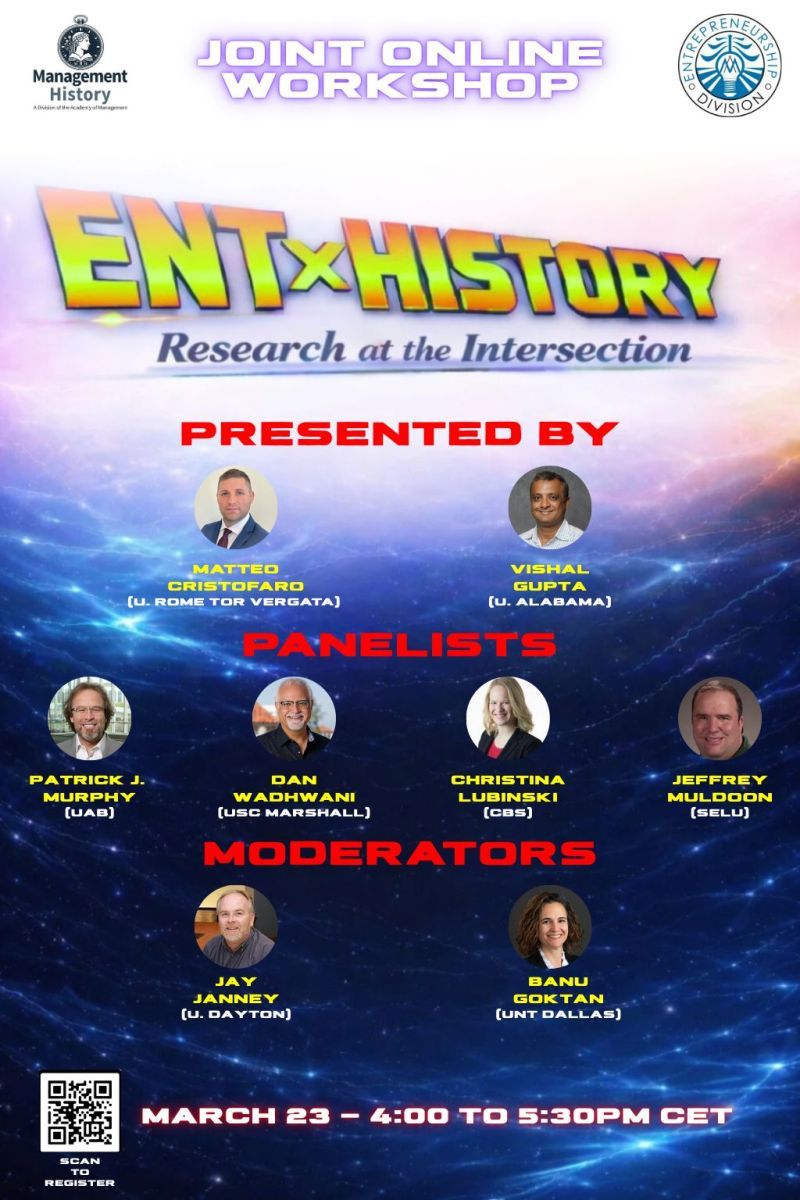
On March 23, 2026, the Management History Division, together with the Entrepreneurship Division, held the online workshop “ENT x HISTORY: Research at the Intersection”. This was the first joint event of this kind between the two divisions.
The workshop focused on a central question: what can history contribute to entrepreneurship research? More specifically, the discussion examined how historical perspectives and methods can help researchers develop stronger questions, clearer explanations, and more robust theory.
The workshop opened with remarks by Matteo Cristofaro, Chair of the MH Division. He argued that entrepreneurship research has often used history only as background context, without fully engaging its methodological and theoretical value. He suggested that historical inquiry can help researchers think more carefully about time, process, and causality. Vishal Gupta, Chair of the ENT Division, continued this line of thought. He stressed that history is not simply descriptive background. It can help scholars understand how entrepreneurial action develops over time and how it is shaped by institutions, constraints, and turning points. He also emphasized the value of dialogue between the two divisions.
The first guest speaker was Christina Lubinski (Copenhagen Business School) who argued that entrepreneurship should be studied not only as an economic or organizational phenomenon, but also as a broader social idea. She noted that entrepreneurial language now appears in many parts of society, including government, universities, and education. Her presentation suggested that historical research can help explain how entrepreneurship acquired this broader social role. In this sense, history does not only provide context for entrepreneurship; it also helps explain how entrepreneurship itself became an influential concept. Lubinski also made an important methodological point. She warned against referring to “the historical method” as if history were a single, uniform approach. Instead, she emphasized that historical research includes a variety of methods and traditions, and that scholars should be specific about the approach they use. She illustrated this through conceptual history, using the example of the term “hype”. By tracing how the meaning of this term changed over time, she showed how concepts carry assumptions and values from one period to another. Her presentation suggested that historical work can help entrepreneurship scholars examine the language they use and the ideas built into their concepts.
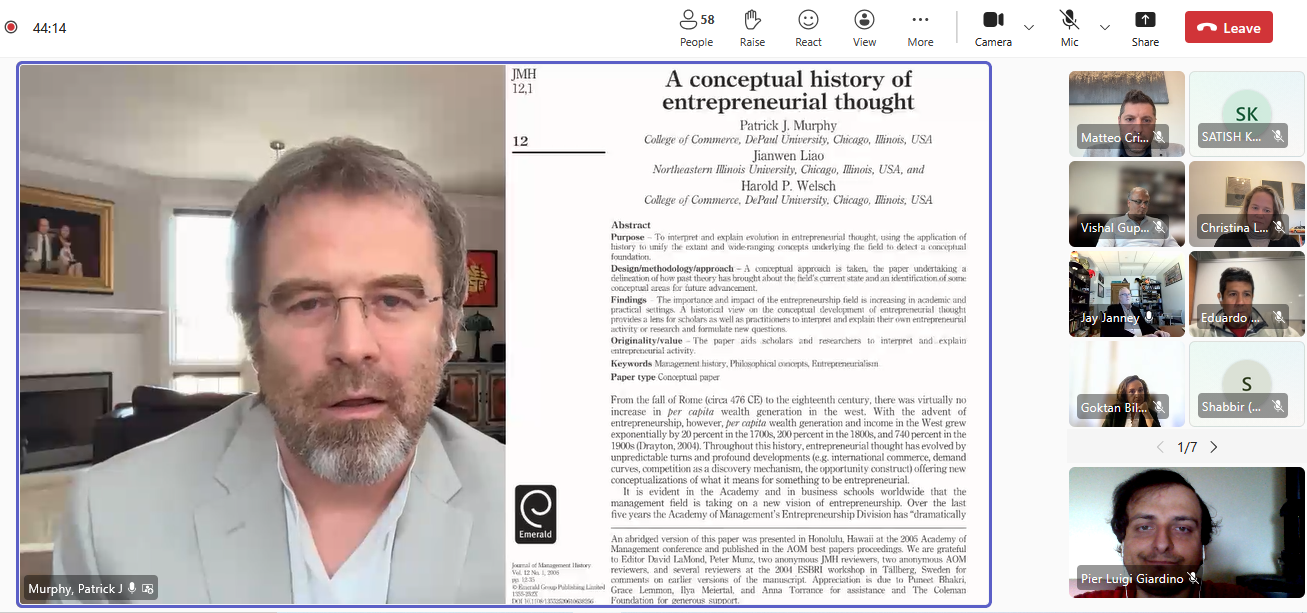
The second panelist was Patrick J. Murphy (University of Alabama at Birmingham) who discussed how historical inquiry has influenced his own research. He described history as a form of disciplined interpretation that requires both evidence and imagination. He also argued that entrepreneurship research is inherently concerned with processes that unfold over time, which makes historical approaches especially relevant. Murphy presented several examples from his own work. He revisited his research on the conceptual history of entrepreneurial thought, showing how the meaning of entrepreneurship has changed over time and how it has not always carried positive associations. He also discussed historical work on service management on transatlantic ocean liners, showing how unusual historical settings can generate useful insight for management and entrepreneurship research. A further example was his work on mutiny, which he used as a way to think about conflict, dissent, and leadership breakdown in entrepreneurial ventures. By studying mutiny in historical seafaring ventures, he identified similarities with entrepreneurial settings, including uncertainty, team formation, and contested authority. Murphy also presented research on an antebellum social enterprise related to anti-slavery efforts. This example showed how historical cases can reveal entrepreneurial forms and practices in contexts not usually considered by mainstream entrepreneurship research. Finally, he introduced the oral history project of the Entrepreneurship Division, which records the experiences of scholars involved in the early development of the division. This project highlights the value of preserving the history of academic fields as well as the phenomena they study.
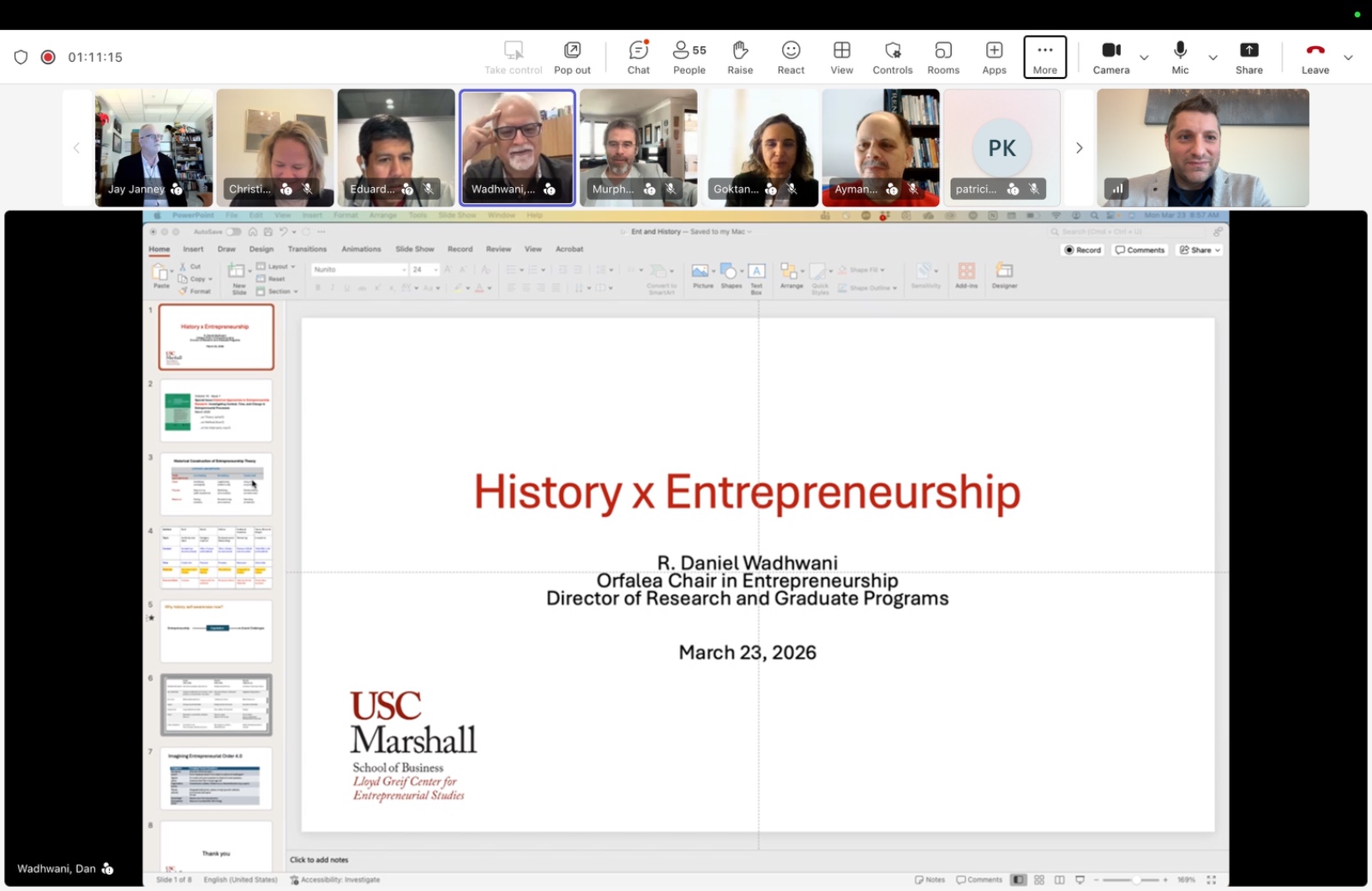
Following, Dan Wadhwani (University of Southern California Marshall) focused on the relationship between history and entrepreneurship at both a conceptual and methodological level. He distinguished between the past, meaning what happened before the present, and history, meaning the interpretation of the past in relation to present questions. This distinction was important to his argument. For Wadhwani, history is not simply a record of events. It is a way of making sense of action, process, and change. He argued that historical approaches are particularly useful for entrepreneurship because they focus attention on context and time, both of which are central to entrepreneurial action. Historical research allows scholars to study how context is formed, how time matters in practice, and how entrepreneurial action is shaped by changing conditions. Wadhwani then outlined several historical approaches that can be useful in entrepreneurship research, including socioeconomic history, cultural history, conceptual history, microhistory, comparative history, and historical case studies. A key point in his presentation was that methodological choices should follow from the research question and from the researcher’s assumptions about context, time, and entrepreneurial action. He concluded by reflecting on the history of entrepreneurship as a field. He suggested that major changes in entrepreneurship scholarship have often been linked to wider social and economic change. This raises the possibility that the field may now be entering another period of change, making historical reflection especially relevant.
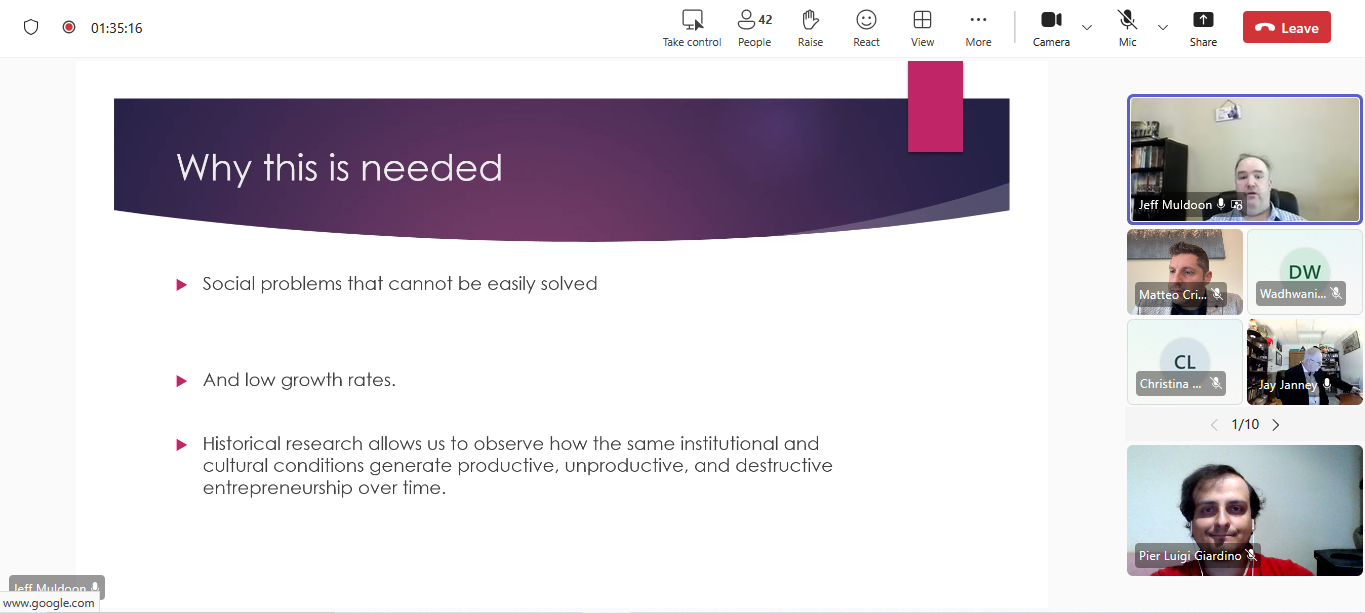
Concluding, Jeffrey Muldoon (Southeastern Louisiana University) addressed the value of history through the distinction between productive, unproductive, and destructive entrepreneurship, following the framework associated with William Baumol. He argued that entrepreneurship research often focuses on productive entrepreneurship because it is linked to innovation and growth. However, history shows that the same institutional conditions can also encourage rent-seeking or harmful forms of entrepreneurship. Historical research therefore makes it easier to see the full range of entrepreneurial activity. Muldoon used examples such as Britain’s historical development and Coca-Cola’s support for Prohibition to show that productive and unproductive entrepreneurship can exist together. These examples illustrated how historical analysis can reveal complexity that may be missed in more limited research designs. He also connected these issues to current concerns, including environmental entrepreneurship, public-private responses to social problems, and questions about low growth and institutional rigidity. His presentation showed how historical approaches can support more balanced and careful theory building.
Concluding, the panelists discussed whether current conditions may represent a new turning point for entrepreneurship research. In this regard, Murphy suggested that present developments may indeed require new thinking in entrepreneurship theory. He argued that some existing frameworks may no longer be sufficient for understanding how entrepreneurial action takes shape in changing contexts. Muldoon agreed that current changes are significant, while also stressing the need for careful interpretation. He suggested that scholars should pay close attention to how organizational forms, institutions, and patterns of work are changing, and to what these changes may mean for entrepreneurship research.
The workshop showed the value of closer exchange between the Management History Division and the Entrepreneurship Division. It also showed that historical approaches can make a substantive contribution to entrepreneurship research by improving conceptual clarity, strengthening explanation, and widening the range of questions scholars ask.
We thank all presenters, panelists, moderators, and participants for their contributions to this event.
A recording of the entire event is available here: https://shorturl.at/BR7Fj